

Beyond the Selection Panel: The Administrative Reality of Public Art

In my previous posts, I’ve explored challenges in artist selection processes. But here’s what I’ve realized: even the best selection process will struggle if the administrators managing it are under-resourced, undertrained, and excluded from decision-making.
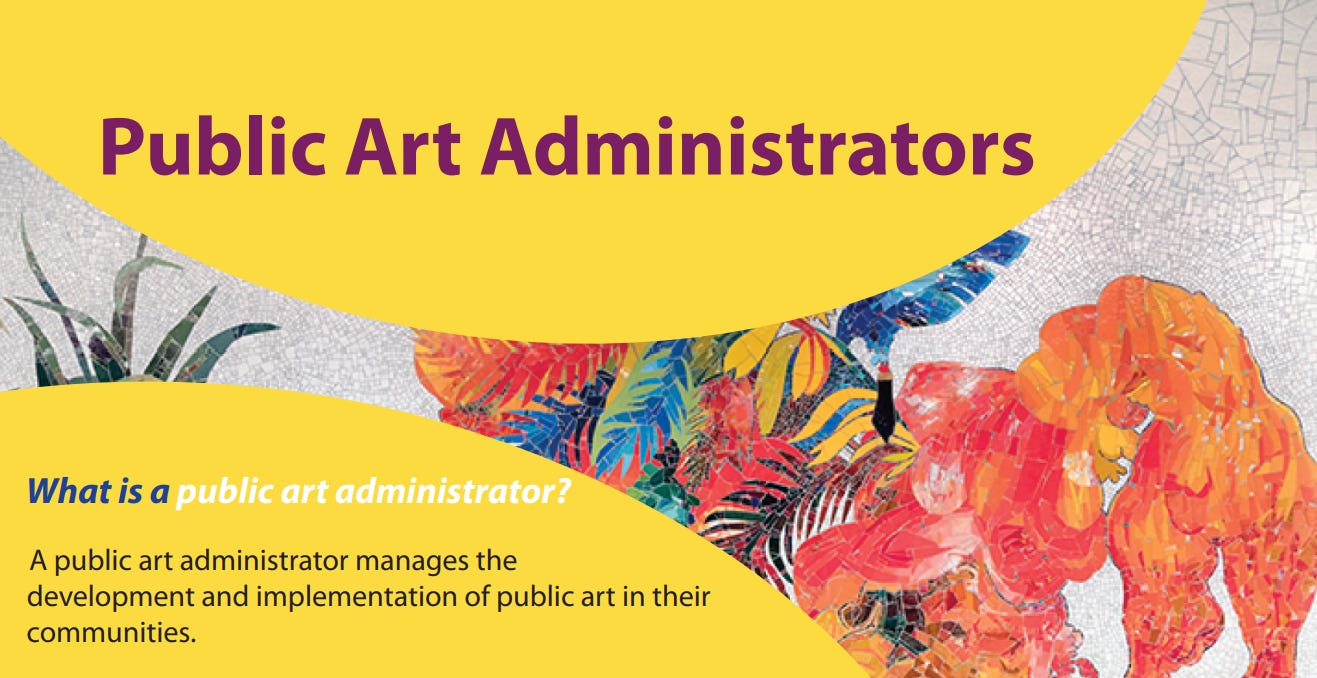
Public art administrators play a defining role in how artists are selected for public art projects. Public art administrators—sometimes noted as project managers—facilitate the project from selection process to installation. Depending on the size of the project or the commissioning agency, this could be one person or a team of administrators working on the project, though there is typically at least one lead administrator to keep things organized.
The administrator is the one who assembles the call for artists, posts and manages the responses, and organizes and facilitates the selection process. Though the administrator, or project manager, may be the one facilitating the selection process, and may have even had a hand in developing the process, there are still challenges that plague public art administrators that directly affect artist selection outcomes.
The Administrator’s Voice in Selection
Though the public art administrator may be the one facilitating the artist selection process, it’s common for them to not have a vote or voice in who is ultimately selected. This is standard in public sector work, though in the private sector there is typically either an in-house or hired curator who participates in selecting artists.
For public entities, this seems odd to me. On the surface, the argument is to maintain an arm’s-length separation between decision-making and the city managing the project. However, in most cases the public art manager has the most knowledge about the project and is aware of which artists are good to work with and which aren’t—yet they’re excluded from voicing this expertise. Moreover, the project manager will spend the most time with that artist working on the project, but doesn’t get even a vote in the decision?
I’ll share a personal example. In my last year working at the City of San José, I managed an artist selection process for a lovely community group who wanted to beautify a neighborhood park—a simple but meaningful request. The park department found funds for a small project that meant a lot to the community.
When the selection process was winding down, the top two contenders were a well-known local artist with public art experience versus someone with similar material skills, though not as well-known and no public art background. The well-known artist was voted by the community to get the project, which from my perspective was unfortunate. The artist was, to be blunt, difficult to work with. They were well known, and that isn’t always a good thing.
I personally thought the lesser-known artist would have been a much better fit with this particular community and would have done just as good a job—but I had no say. My first phone call with the selected artist started badly as they tried to bully me into making a business decision that wasn’t mine to make. Their first encounter with the community group was uncomfortable; they were completely out of their element and annoyed because the community members “wouldn’t listen to them.” That wasn’t the case, there were just different communication styles, and if you’re going to work in public art with the public, you need to work well with all sorts of people.
My position with the city ended before that project progressed much further. Though that meant I didn’t have to continue working with that artist, I did miss working with that amazing community group. Ultimately the artwork was completed, but at what cost?
Are we as public servants supposed to just accept bad behavior? What about standing up for the community or for artists? This needs real thinking and change in how public art is commissioned by public entities.
Public art program staff should be able to be part of the selection process. Not to dominate it, but to contribute their professional expertise, their knowledge of artist track records, and their understanding of community dynamics. Their exclusion in the name of objectivity may actually be creating worse outcomes.
Doing the Work vs. Rethinking the Work
In my conservative estimation, I would guess there are between 1,000 to 1,500 public art administrators working around the United States considering municipal programs, non-profit organizations, freelance consultants, along with curators and project managers in the private sector. This is based on my engagement with public art professionals during my nine-year tenure facilitating the Public Art Network of Americans for the Arts, which at the time was the only nation-wide community of public art administrators, artists and other professionals. Additionally, in 2017, I worked on a survey of over 700 public art programs across the United States which highlighted capacity challenges among this unique professional group, including:
68% of responding programs have at least one full-time employee either dedicated to managing the program (39%) or handling it as one component of a multi-departmental role (31%)
61% of programs serving areas over 1 million population have at least one full-time dedicated staff member
16% of programs in areas under 100,000 population have no staff at all
These statistics reveal challenges not just with doing the work, but with finding time to rethink how artist selection works. This isn’t meant to excuse why change doesn’t happen, but rather to acknowledge with compassion that workload constraints is something we should all consider as we look at new ways to address challenges within public art processes.
The Training Gap
Another major need in the public art field is training for public art managers. Currently, only three to four college-level programs exist for people who want to administer public art projects—and these projects are complex. Most administrators I’ve encountered have varying backgrounds in the arts, whether as trained artists or, in one case I worked with, from a construction background.
At times there are opportunities through informal channels—webinars hosted by other public art professionals or conferences for learning and knowledge exchange—but these are few and far between, with no standards. I myself have an undergraduate degree in studio art and a master’s in arts administration, and I took exactly one course on public art management during my entire education. The rest came through volunteer work, internships, and on-the-job learning.
There is a very strong need for some kind of formal training in public art. Many of the issues facing the public art field I believe could be better addressed through more investment in education and knowledge-sharing among new and current administrators along with cross-collaborations of artists and community organizers.
Moving Forward
There is a lot to consider when shifting the way things have always been, but I think we’re at a time that needs new thinking and dedicated investment in training to build better, more equitable processes. One of the reasons I created Public Art Curious was to bring these issues to light and drive new voices and focused conversations around the public art field—especially around who administers projects and how. In fact, if anyone is interested in building a public art administration training program, whether a formal educational program or a cohort of practitioners, reach out. I’d love to partner.
So, here’s what I’m wondering: What would it take for your organization or community to give public art administrators a seat at the selection table? And what kind of training or support would help administrators navigate these complex processes more effectively?
Your analysis of the administrative reality of public art exposes the human reality of a system that prioritises bureaucratic distance over the essential professional expertise required for successful community projects.
Great to have your voice here on Substack, Patricia. Subscribed and look forward to reading more. I would love you to do the same, if my writing resonates.
Re: training for public art administrators. I think there is a lot that can be replicated from construction and design project management best practices. For example, architects and landscape architects have construction administration best practices and the builders and contractors all speak that language. For the big percent for art commissions I have done, knowing those best practices has helped me as an artist. I wish more public art administrators were well versed in things like construction schedules, permitting submittals, and change orders.
I also agree with you about the administrator needing a vote in the artist selection process.